We are all well aware of toy franchising and how companies have made fortunes on the backs of block buster movies and popular television series. Yet before the advent of the motion picture, playthings, and in particular those of a militaristic nature, were often inspired by current events. For instance, during the mid nineteenth century the Crimean War was not only capturing the attention of the world’s press, but also that of the Germanic pewterers and among the pieces they produced was the “Siege of Sevastopol”. In January 1855, a Virginia newspaper published information from a correspondent in Paris who said that this “new and popular” plaything could be found in “every toy shop in Paris.”1 However, by the early 1860s there was another conflict which was challenging the skills of several Teutonic tin-smiths, the American Civil War. With exports in mind and orders coming in from American fancy goods dealers, they began casting “tin-flat” figures representing the Confederate and Union armies. In fact, following the naval engagement in Hampton Roads, Virginia, on April 8-9, 1862, J. C. Allgeÿer of Fũrth even produced “tin-flat” toys of the vessels concerned.2 No doubt, such items found a ready made market in America, but when it came to some of the other martial playthings that were turned out during the early 1860s, such as the “Camp in Kentucky”, in comparison sales must have been rather limited.
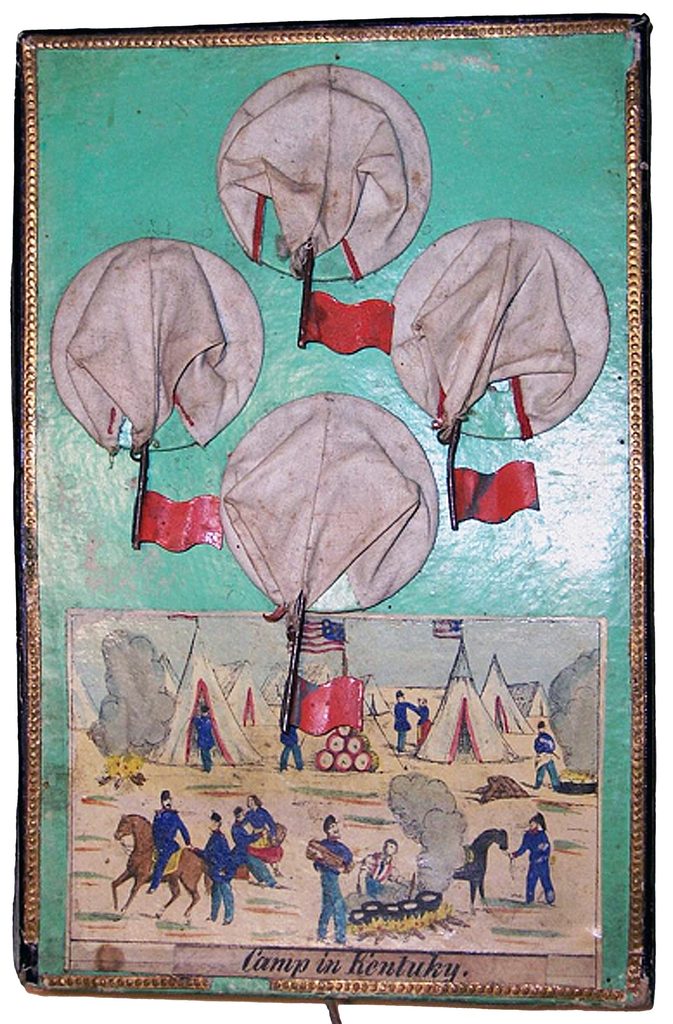
The first person to attempt to cover such items in Old Toy Soldier Journal was Earl Jorgensen when he wrote “Before the Tin Army of The Potomac: Early German-Made, American-Themed Toy Soldier Sets” (OTS Magazine, Vol 38, No 3, Fall 2014). Touching upon the subject of toys like “Camp in Kentucky” (Illus. 1 & 2) and “Camp of Americans” (Illus. 3) he suggested that they were probably inspired by the encampments that sprang up across the nation during the Mexican War of 1846-1848, following President Polk’s “call for 50,000 volunteer soldiers to supplement the existing American military forces…Individual states and territories were each assigned a volunteer quota…”3 Quite a logical assumption perhaps if these playthings had been made during the years immediately following the conflict with Mexico, but had they? We will never know for sure, but what little evidence there is tends to indicate that these toys could not have materialized until around 1860-1861 at the very earliest, by which time the Mexican War was no longer a current event. Indeed, the majority of the children for whom these items were intended had probably not even been born when the conflict with Mexico was raging. While Mr. Jorgensen’s theory may very well have been correct, there is another distinct possibility that these toys may have been inspired by the annual volunteer militia encampments that were held across the nation during the period. Such events were reported in the press and sometimes depicted in illustrated periodicals. Inevitably they often became huge public attractions and not only for adults, but also for children and, no doubt, they influenced their play. Evidently one boy who paid attention to the militia was John S. Wise, the young son of Governor Wise of Virginia. In 1859 New York’s esteemed 7thRegiment ventured to Richmond on a good will visit. Up until then Master Wise had regarded the Virginia troops as “perfection itself”, but after witnessing the absolute uniformity of the 7th, he now deemed the Virginia men as “a mere incongruous lot of painted toys…”4 So what were these militia encampments which probably influenced children’s play and may have prompted some German tin-smiths to make representative toys?
By the 1850s the “common” militia musters, which all able bodied males within the ages of military obligation were obliged to attend, had largely fallen into disrepute. What remained were the “active” organized militia outfits and many had often gone under canvas for two or three days each year to enjoy a round of barbecues and target shoots. However, in 1849, Massachusetts introduced annual encampments for its entire organized militia and they must have been a success because other states were to follow. By 1860 these “active” militia gatherings had become quite a conspicuous feature of the autumn landscape.5 In fact, some even made those of the Mexican War pale into insignificance and this was touched upon by Brigadier General Benjamin F. Butler of the Massachusetts Volunteer Militia when referring to the camp held in Concord in 1860. Amounting to nearly six thousand men, he remarked that he “had seen together, for discipline, instruction, and military movement, a larger body of troops than even General Scott had seen together, for he had never had so many in one body in Mexico.”6
It is also plausible that some encampment sets may have been inspired by the wartime volunteer sites that sprang up across the country following the outbreak of hostilities between the North and South. For instance, one noted rendezvous that appeared in Kentucky during the Fall of 1861 was the pro-Unionist Camp Crittenden.7 However, it is highly unlikely that this was the event which prompted the making of the “Camp in Kentucky” toy. Yet one set that may have been inspired by a wartime site was that entitled “Camp in Virginia” (Illus. 4). Like those of the “active” militia, these 1861-1865 volunteer encampments also attracted children, and troops relished having visits from them when their units were posted near villages and towns.8
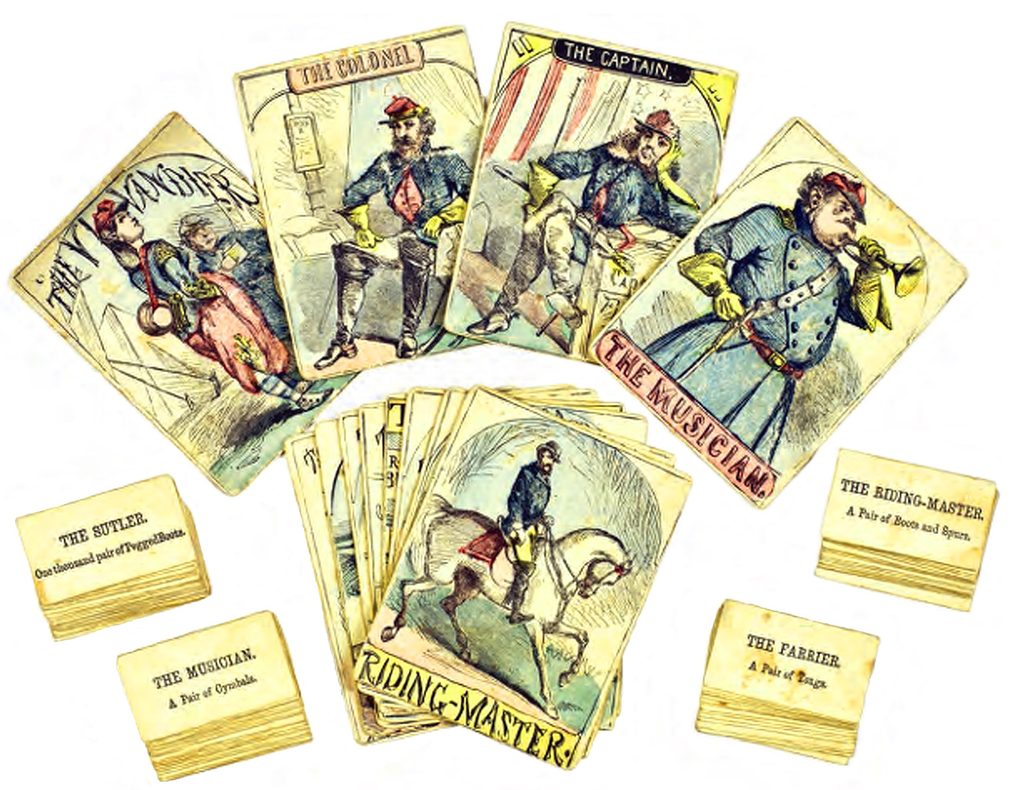
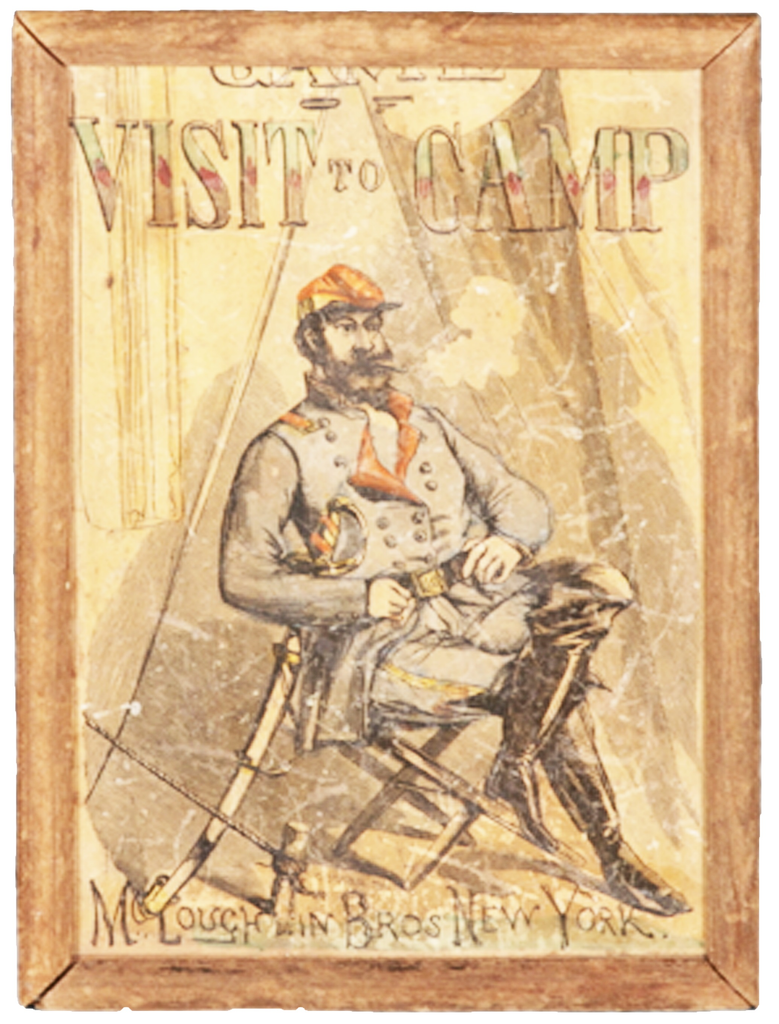
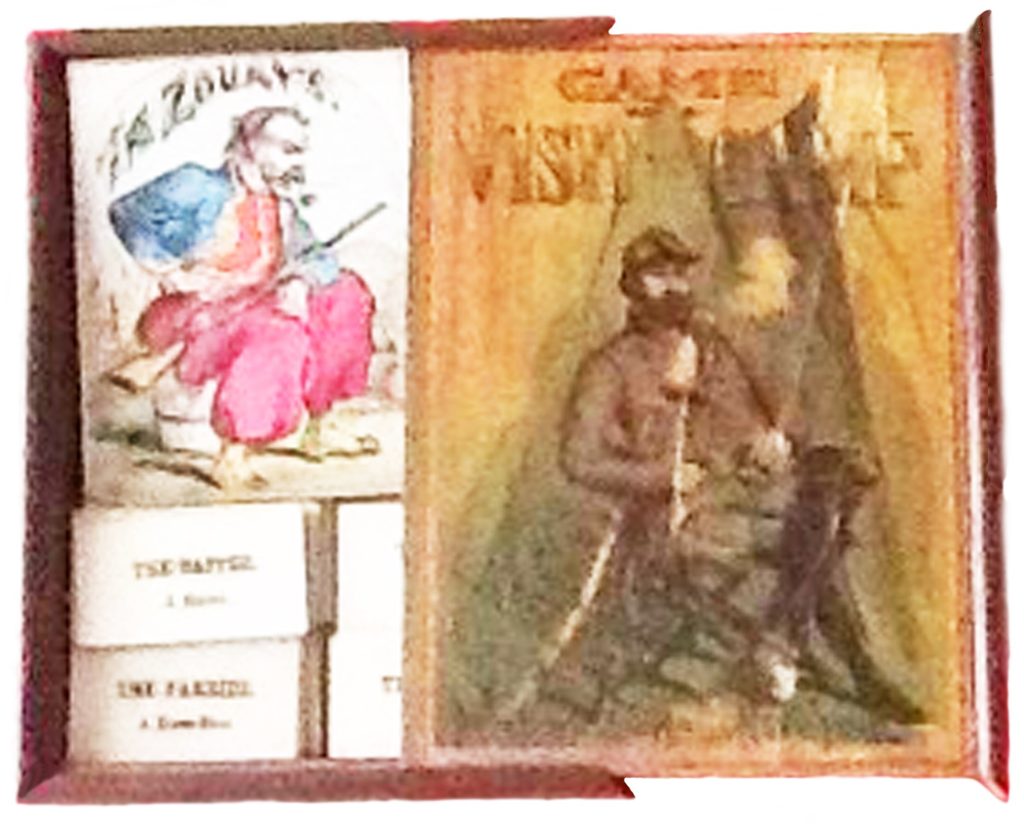
While the ending of hostilities in 1865 did spell the end of the wartime volunteer sites, the annual militia encampments, often continued, at least in the North. Thus it is possible that some German-made American camp sets containing “tin-flat” toys may have been produced during the post-war era before the widespread manufacture and introduction of “semi-solid” and “solid” figures. Undoubtedly these military gatherings must still have remained a popular topic with the public, because around 1871 even McLoughlin Brothers of New York City were inspired to produce a “Visit to Camp” card game. It offered a lighthearted view of camp life and the cards themselves depicted caricature like impressions of military personnel, such as a bewhiskered colonel, a rather foppish captain, a hapless surgeon, and a hard-drinking sutler, to name but a few (Illus. 5).9 It has been suggested that this game was introduced around 1864-1865, but all the surviving boxes seem to bear the address of 71 Duane Street (Illus. 6 & 7). Evidence suggests that McLoughlin Brothers did not move to this location until around 1871.10
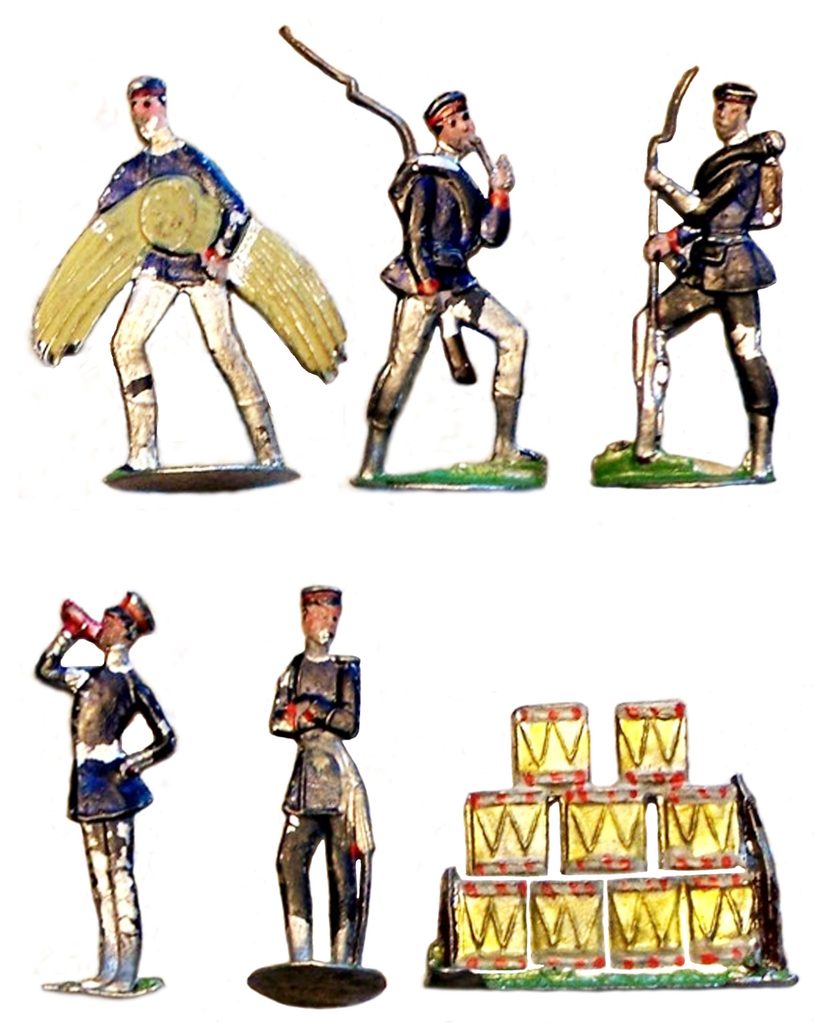
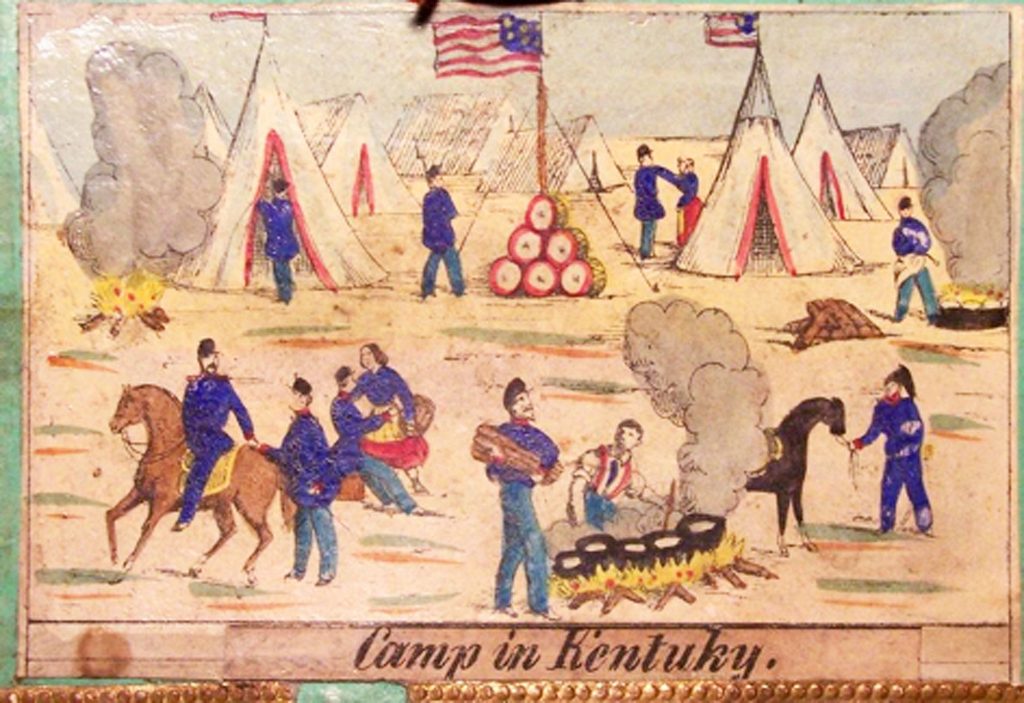
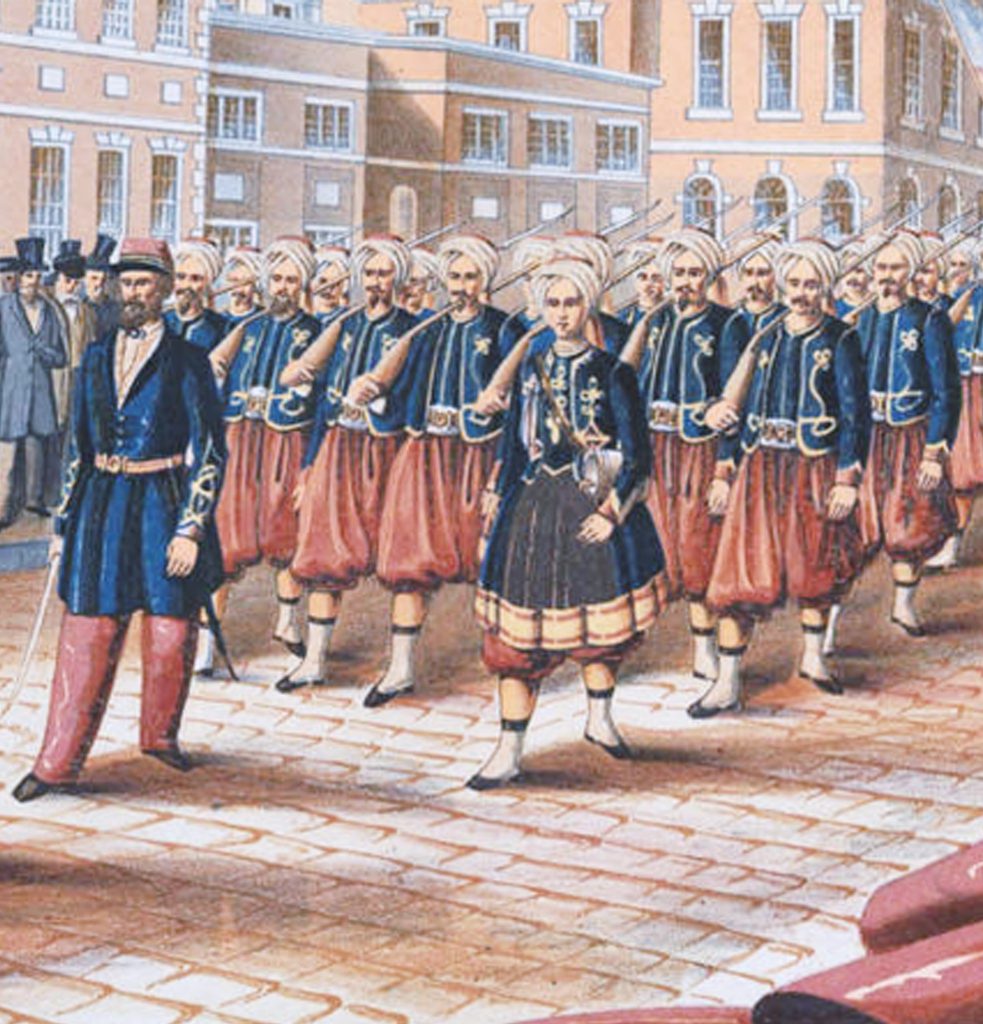
Regarding the evidence as to when such sets as “Camp in Kentucky”, “Camp of Americans”, and “Camp in Virginia” may have been made, without any documented proof in the form of old company records the only other sources left for guidance are the few remaining tin-flat accessories, the wooden boxes in which they came, and the illustrations that adorn the box lids. Of course, because the German tin-smiths also made encampment sets for other markets, it is plausible that not all of the items contained in the American sets were made specifically for them. For instance, those few surviving figures accompanying the “Camp in Kentucky” toy do seem to have a somewhat Germanic style look to their campaign dress (Illus. 8). In all likelihood the best indicator as to the date of manufacture of these sets are the hand colored woodcuts that adorn the box lids and although probably representing little more than an eye-catching visual to capture the attention of children, they still tell us quite a lot. For instance, that decorating the Kentucky set (Illus. 9), among other troops, depicts a couple of vivandieres while that of the “CAMP OF AMERICANS” shows both vivandieres and Zouaves. While it may have been preceded by some earlier units, the first widely publicized Zouave company to appear in America was the United States Zouave Cadets in 1859. Naturally others soon followed, including the Philadelphia Zouave Corps, which was organized around February/April 1860. In fact a circa 1861 chromolithograph of this outfit even pictured them with a Vivandiere (Illus, 10). Whether this was the first American Zouave command to be accompanied by such a lady the writer does not know.11 Also shown in the “Camp in Kentucky” and “Camp of Americans” illustrations are troops donning dress caps, which appear to resemble the French military’s casquette d’ Afrique, a headdress developed by that nation’s army during its conquest of Algeria. A near identical piece was adopted by the United States Army in 1851 and again in 1854. Although eventually to be superseded in the regular service by a black felt hat, yet in 1872 a more modern looking variant of the dress cap was to return. In effect it was a cut-down version of the 1854 pattern. However, in the militia, shakos in one form or another never really went out of favor and continued to be worn by numerous units throughout the period. Also depicted in these woodcuts are men wearing fatigue caps, but not of the 1839 style often associated with the Mexican War, but of the pattern fashioned on the French Army’s bonnet de police á visiėre. Evidently the first unit to wear this type of headgear in the United States was the Albany Burgess Corps. This New York independent volunteer company began wearing the piece around April 1857 and during the following year a forage cap of a similar appearance was prescribed for fatigue wear for the United Sates Army. From then on its use soon spread and by 1861 many volunteer militia commands were wearing kepis in one form or another. Also notable in the “Camp in Kentucky” and “Camp of Americans” prints are mounted troops wearing helmets. At first glace these give the impression of being of the type introduced in 1872 by the United States Army for its light artillery and cavalry arms-of-service.12 Yet this likeness may have been pure coincidental and what the Teutonic artist was probably trying to interpret was a dragoon style helmet of a pattern worn by several mounted militia outfits during the era. However, one factor which probably cannot be used for guidance is the colors of uniforms depicted in these prints, because the person who hand tinted them was most likely using black and white woodcuts for guidance and automatically assumed that the clothing would have been blue. Nevertheless, taking all these different elements into consideration tends to indicate that none of the illustrations concerned could have rolled off the press much before early 1861.
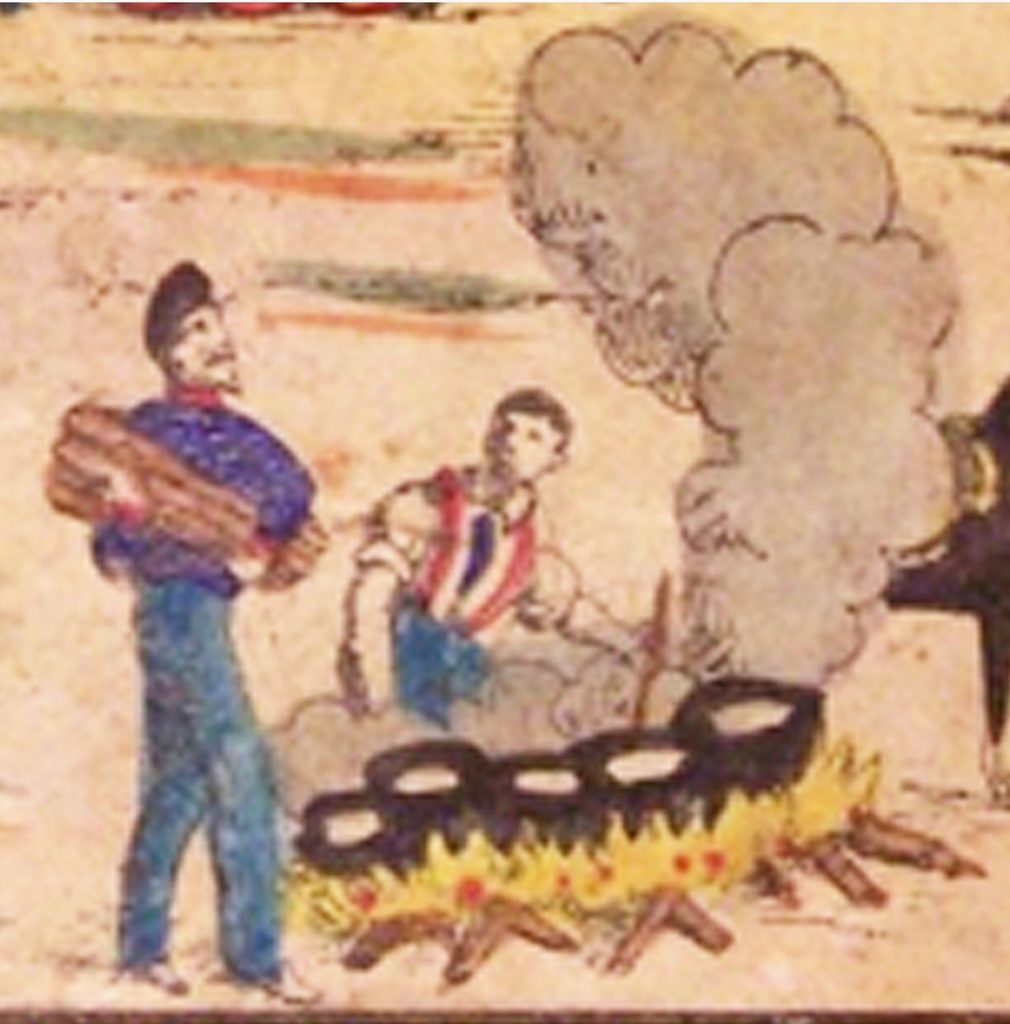
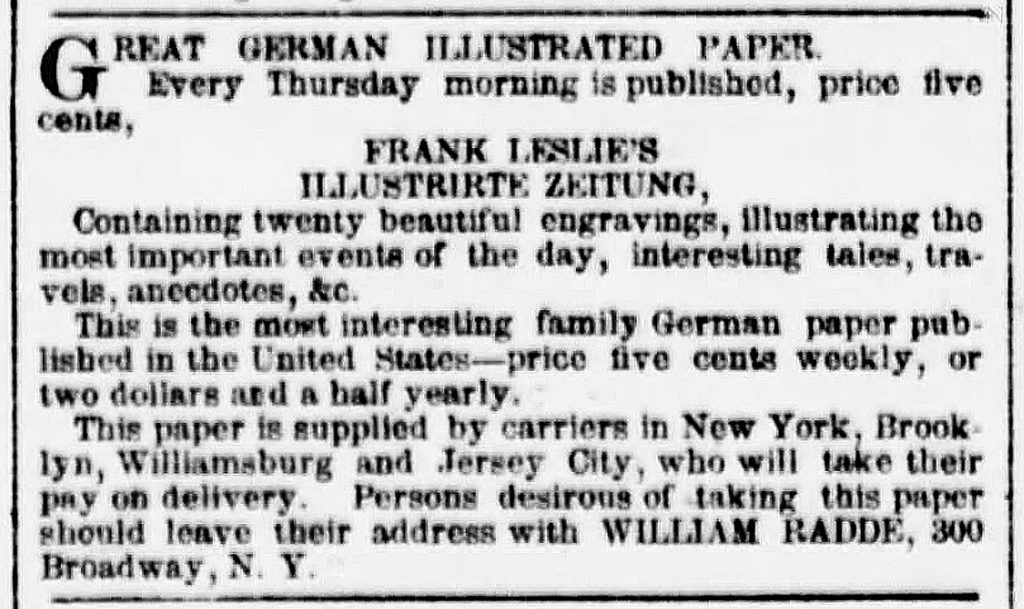
While companies such as J. C. Allgeÿer were noted for making early “playsets,” and although we will probably never know for sure, those entitled “Camp in Kentucky” and “Camp in Virginia” are believed to have been made by the firm of Johann Haffner, Pewter Founders, Fũrth.13 If correct it is also feasible that Haffner also produced the “Camp of Americans” because not only is the artwork of a similar style, but some of the figures pictured are near identical to those depicted in the Kentucky print (Illus. 11 & 12). As to what sources the artist (or artists) used for reference we can only surmise, but undoubtedly there were many impressions available, including those that appeared in American illustrated periodicals published by the likes of Harper Brothers and Frank Leslie. In fact, Leslie even produced a German language version of his newspaper, it was called Frank Leslie’s Illustrierte Zeitung (Illus. 13).14 No doubt, it is possible that copies of these United States periodicals found their way across the Atlantic and into the hands of the Teutonic toy makers who upon scouring the pages came across ideas for potential militaristic toys for the American market and this brings the “Camp in Kentucky” set to the fore. Indeed, why Kentucky because during the period it was not a particularly industrial Commonwealth? In 1860 its population was largely rural and consisted of 919,484 whites, 10,684 free colored, and 225,483 slaves. Agriculture was the State’s mainstay, especially in the cultivation of grain and tobacco.15 Of course, being predominantly an agrestic locale leads to the question why was such an exquisite plaything made representing its military? While there are several possibilities, one stands out above the rest and the event concerned even drew the attention of Frank Leslie. So what was it?
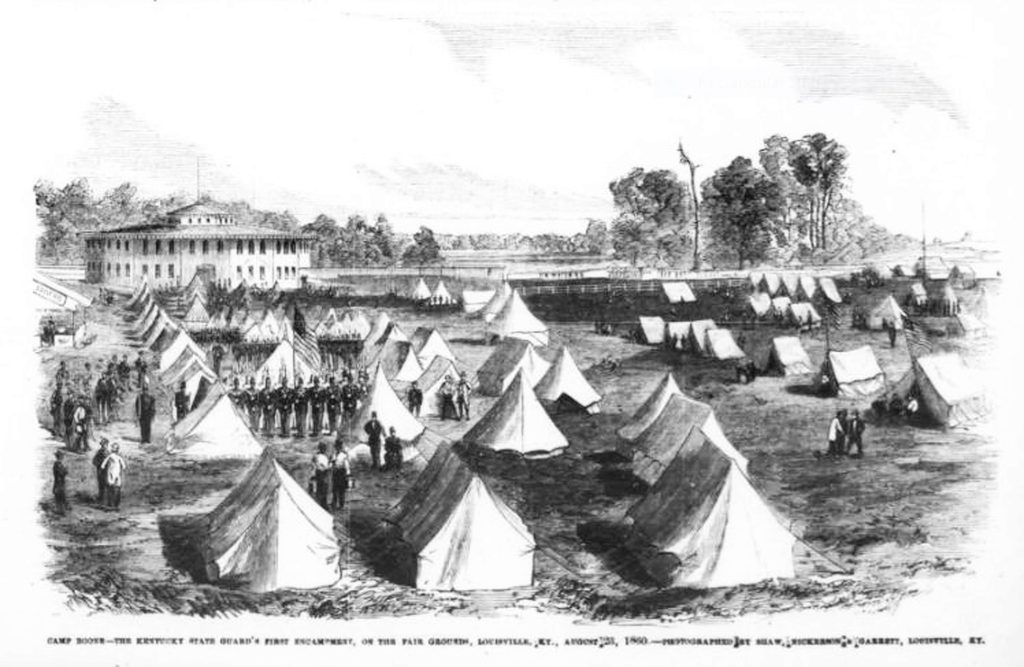
Although Kentucky only ranked ninth in the Union population wise, it did have one of the best organized militias in the country and this was largely due to John Brown’s raid on Harper’s Ferry in Virginia in 1859. Like other slave states, after this incident Kentucky grew concerned about its safety and decided to reform its military.16 On March 5, 1860, it enacted a militia law that created “three classes of militia – the Active or Volunteer, the Enrolled, and the Reserve.” The “Active” volunteer element was designated the “Kentucky State Guard” and was “to be regarded as a single army corps…”17 In June it was “proposed to hold the first encampment in the vicinity of Louisville” with the possibility of holding “local encampments…later in the summer, or in the autumn, at other points – one in the vicinity of Lexington, and one at some point in the Green river country…”18 The first encampment was called Camp Boone and it took place on the Fair Grounds in Louisville from August 23, to August 30, 1860. The companies of the State Guard present were the Louisville Life Guards, Citizen Guards, National Rifles, Lexington Rifles, Union Greys, Jackson Guards, Marion Rifles, Warren Voltigeurs, Newcastle Guards, Shelby Guards and Citizens’ Artillery.19 Besides these it was also frequented by a “large number of young and old gentlemen…in the undress of many corps” who “were for the most part officers of unattached companies.”20 Others in attendance included the “officers of the Guthrie Greys, of Cincinnati,” and the United States Army’s band “from the Newport Barracks…”21 Roughly three thousand troops participated and several images of the event were taken by the photographers Garret & Nickerson of Louisville. These were published in an album by G. T. Shaw.22 However, on October 6, 1860, a woodcut of the encampment even appeared on page 315 of Frank Leslie’s Illustrated Newspaper (Illus. 14). Although the writer has not been able to track down a copy of the relevant issue, this very same picture probably also appeared in Leslie’s German language edition. Of course, this leads to the question, was a Teutonic toy maker inspired by this engraving to make the “Camp in Kentucky” set as a speculative venture? Yet another possibility is that although prompted by Camp Boone, it may have been made to order. However, whether it was produced after 1861 and inspired by a Kentucky military rendezvous during the wartime years or the following readjustment era, is extremely doubtful and there are several reasons for this.
Being a border state its population had divided loyalties and although the Kentucky legislator attempted to keep the State neutral it was an impossible task. Inevitably both Union and Confederate commands were to be formed of Kentucky citizens. Indeed, many members of the State Guard were pro-secessionist and fought for the Southland,23 and in their place pro-Union men organized companies of Home Guards for local defense. During the conflict the Commonwealth was plagued by both northern and southern invading armies, not to mention small raids by Confederate partisan rangers and forays by bands of guerrillas who owed allegiance to neither side. These sorties increased in frequency as the war progressed and in many counties there grew a noticeable lack of enthusiasm for military service of any sort. Although the majority of Kentucky citizens sympathized with the Union, the emancipation of slaves without compensation even to loyal owners, the arming of Negro troops, the arbitrary imprisonment of citizens and the interference of Federal military officials in what were thought to be purely civil affairs, had aroused considerable resentment by the war’s end.24 What is more, the State’s troubles did not end in 1865. After the cessation of hostilities some of its regions became lawless strongholds and these troubles continued into the 1870s. While efforts were made to revive the State Guard, nothing was really achieved until after 1872.25 Of course, taking all these difficulties into consideration tends to suggest that there would not have been a market for this “Camp in Kentucky” toy after say 1861.
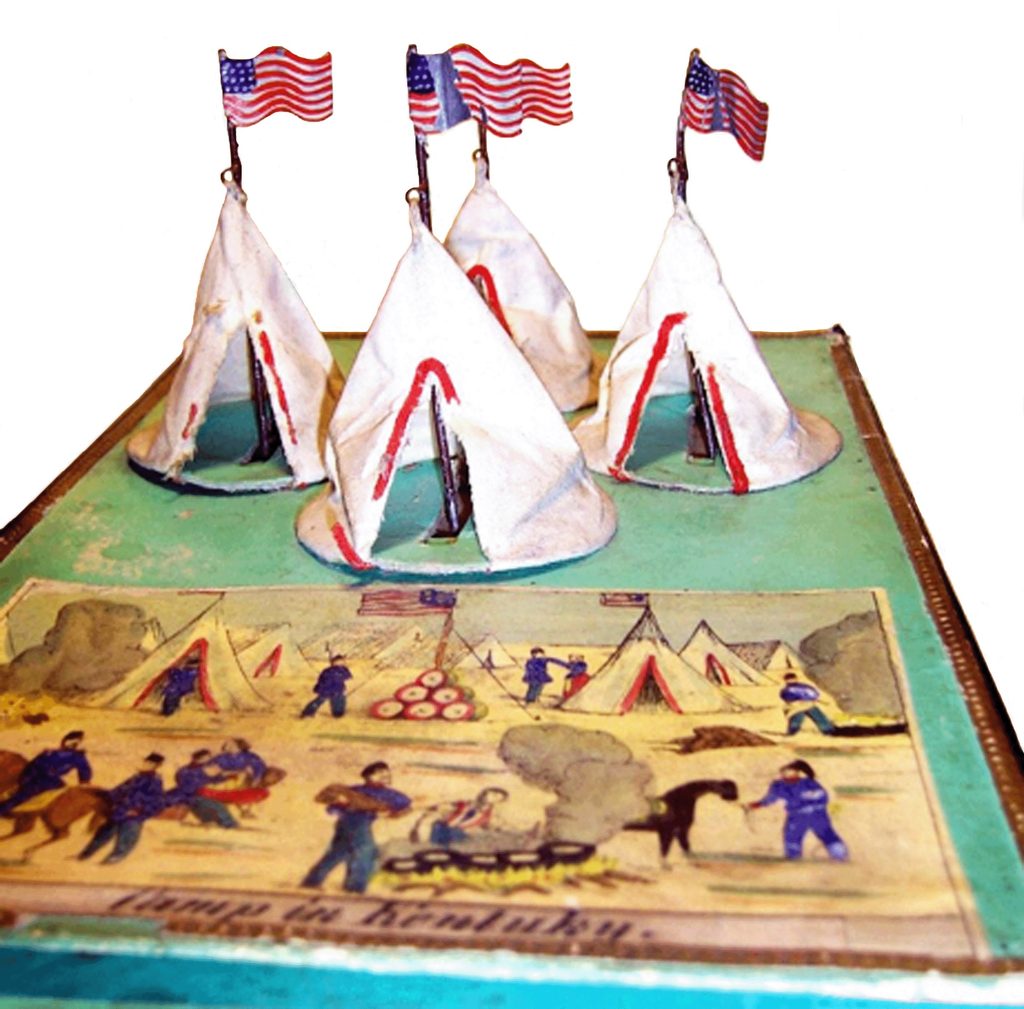
As for the “Camp in Kentucky” toy itself, the box top does not lift or slide open, but merely provides a surface for the illustration and the four permanently attached cloth tents. A small opening located at the front of the box provides just enough space for a much smaller box to slide out which contains the figures and a short piece of silk ribbon to operate a pull-tab device to raise and lower the tents (Illus. 2).26 Undoubtedly this toy is quite elaborate and during its day must have been expensive to produce and therefore buy. Sales were probably very limited.
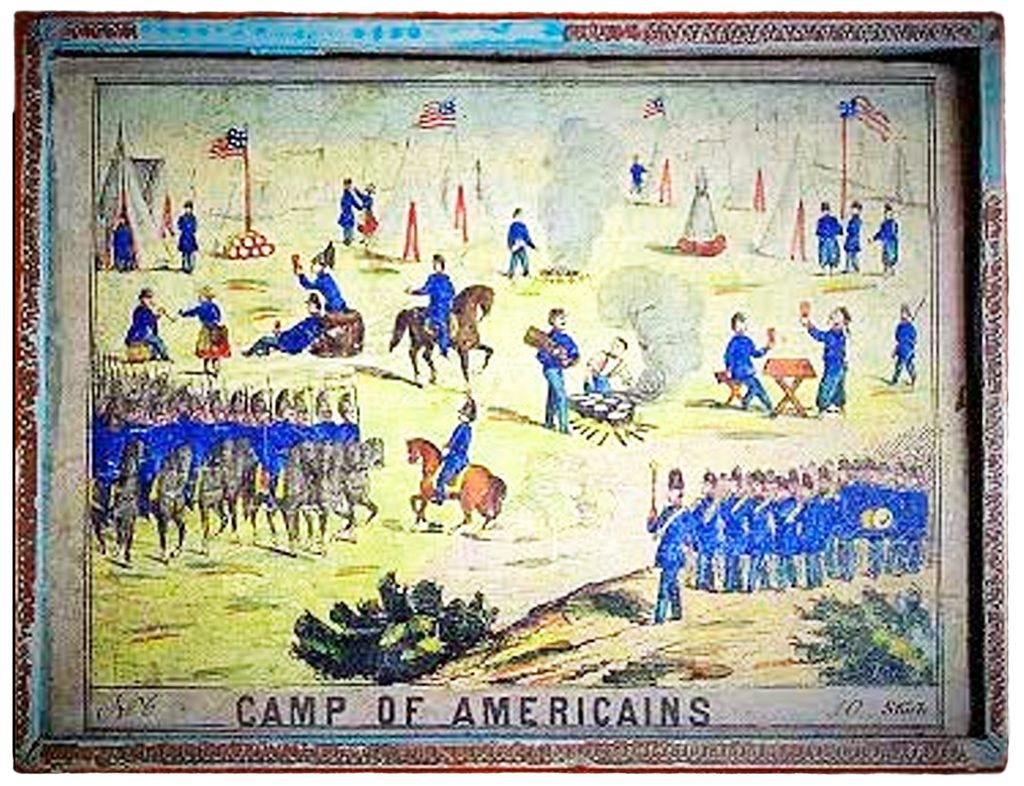
Regarding the set entitled “Camp of Americans” (Illus.3), little more can be said except that the box’s illustration depicts all the uniform elements previously referred to, which suggests a production date of the early 1860s. No doubt because of the set’s rather generic name it could have been sold anywhere in the country.
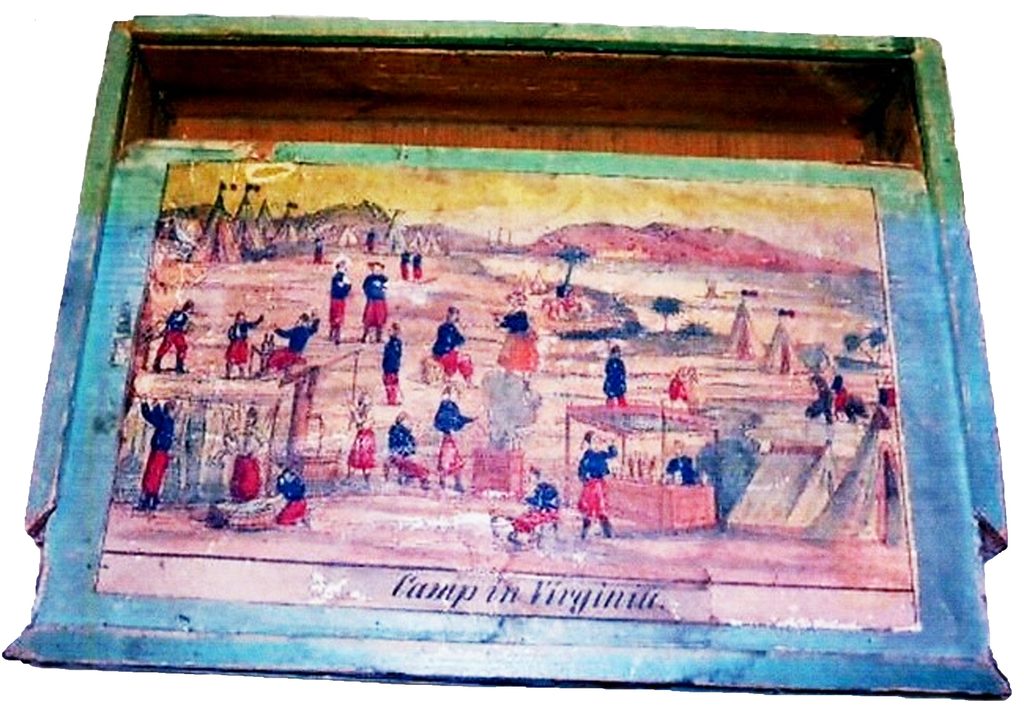
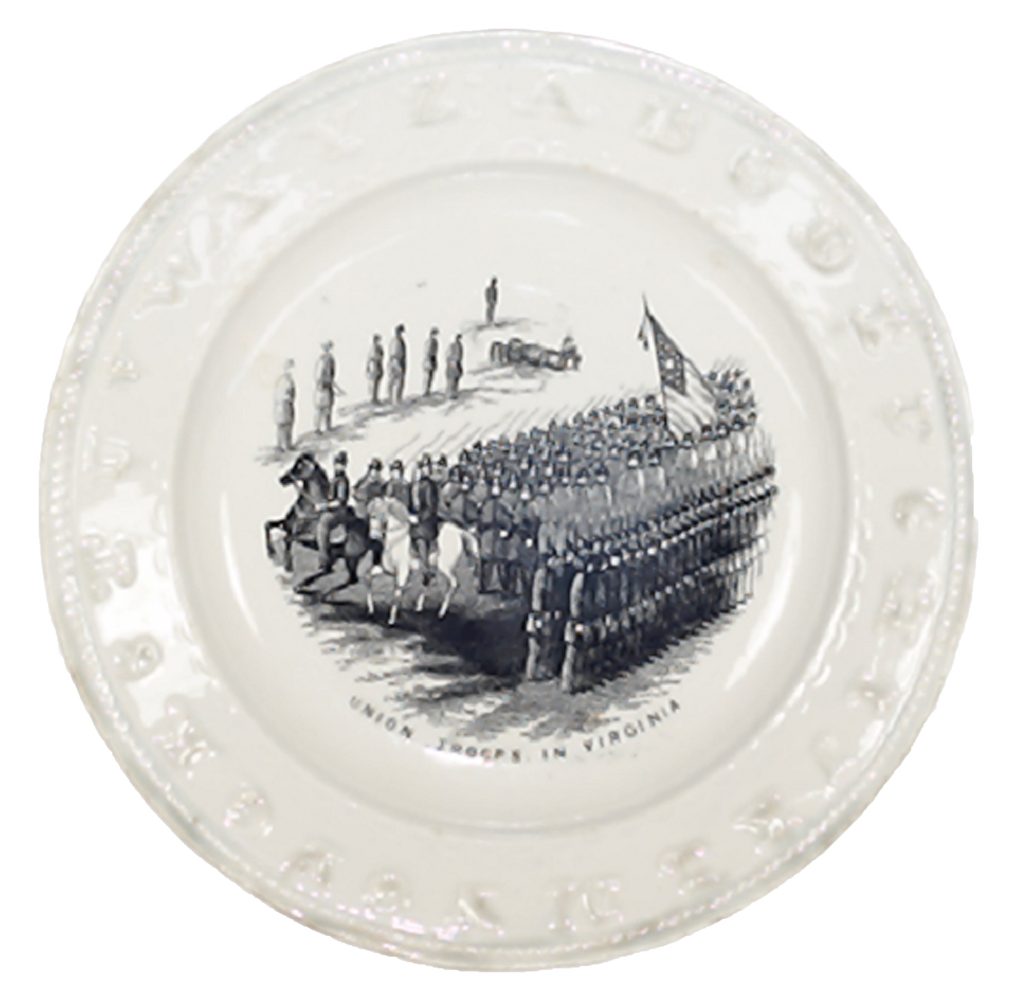
The third and final set to be considered is that entitled “Camp in Virginia” (Illus. 4). Sadly its contents are now missing, but if the print on the box did symbolize more than just mere artistic license and the set did once contain “tin-flat” Zouaves, this leads to the question just what outfit were these toy Zouaves intending to represent? Indeed, prior to 1861 it seems that Virginia had no Zouave units.27 Whether this item was ordered and made for some Virginia trader in 1861 or later is unlikely because on April 17, the State succeeded from the Union and joined the Confederacy and during the ensuing four year conflict it was to become the principal battleground for the war in the East. Not an ideal location for a German toy manufacturer to have business dealings in. Yet one possibility is that it was made for the northern market and the toy represented a Union encampment in Virginia. In fact, this is feasible because the writer has come across another children’s item depicting Union troops in Virginia. It takes the form of an “ABC” plate (Illus.15).
Of course, most of which has been said in this article is speculative and borders on pure conjecture and some of the writer’s assumptions may very well be wrong. Nevertheless, during the 1850s and 1860s similar sets must also have been made representing and bearing the names of other states and if so, possibly the same criteria can be used to roughly date yet undiscovered camp set boxes.
Illustrations
Illus. 1. The rather elaborate “Camp in Kentucky” box with tents lowered. By courtesy of Earl Jorgensen.
Illus. 2.”Camp in Kentucky” box with tents raised. By courtesy of Earl Jorgensen.
Illus. 3. “CAMP OF AMERICANS” box. While it bears no maker’s mark, apparently the printed label/illustration does provide information regarding the set’s configuration, it consisted of thirty pieces. By courtesy of Claarje Pennink.
Illus. 4. “Camp in Virginia” box. By courtesy of Earl Jorgensen.
Illus. 5. The McLoughlin Brothers “Visit to Camp” game consisted of twelve chromolithographed character playing cards and seventy-two object cards. By courtesy of the American Antiquarian Society.
Illus. 6. “Visit to Camp” card game box. Made of wood with a sliding lid, it is decorated with a chromolithographed paper label, which bears the address of 71 Duane Street. By courtesy of Jeff R. Bridgman.
Illus. 7. “Visit to Camp” card game box with the lid slid open showing the contents.
Illus. 8. The remaining figures and accessories from the “Camp in Kentucky” set. By courtesy of Earl Jorgensen.
Illus. 9. Close-up of the illustration that adorns the Kentucky Camp box. By courtesy of Earl Jorgensen.
Illus. 10. Portion of a chromolithograph by P. S. Duval & Son, circa 1861. It depicts the Philadelphia Zouave Corps marching down Chestnut Street and among the ranks can be seen a vivandiere. The original painting was by James Fuller Queen. By courtesy of the Library Company of Philadelphia.
Illus. 11. Appearing almost central in the “Camp in Kentucky” print is this scene depicting a soldier carrying a bundle of wood near a camp fire where there is a cook surrounded by pots and pans.
Illus. 12. The near identical scene from the “CAMP OF AMERICANS” print. This suggests that it was undertaken by the same hand as the “Camp in Kentucky” illustration.
Illus. 13. Advertisement for Frank Leslies Illustrirte Zeitung from The New York Herald, New York, New York, Wednesday, December 23, 1857, p. 8.
Illus. 14. The engraving of Camp Boone which appeared on page 315, of the October 6, 1860, issue of Frank Leslie’s Illustrated Newspaper.
Illus. 15. Child’s ABC plate depicting Union troops in Virginia. On its reverse is a somewhat faded typewritten label saying “Baby Plate belonging to Francis C. West, grandfather of Alice L. Patey.” Often bearing the likenesses of generals, evidently these transfer printed children’s plates were made in the Staffordshire potteries district of England and exported to the United States. Writer’s collection.
Notes
1. Daily Dispatch, Richmond, Virginia, Wednesday, January 24, 1855, p. 2.
2. Ignacio Czeguhn, Martin Schabenstiel, Erhard Schraudolph, Alfred R. Sulzer, Robert Lonsing, Zinnfiguren der Offizin J. C. Allgeyer, printed in Austria, 2017, pp. 213-215.
3.Earl Jorgensen, Before the Tin Army of the Potomac: Early German-Made, American themed Toy Soldier Sets in Old Toy Soldier Journal, Vol. 38, No. 3, Fall 2014, Pittsburgh, Pennsylvania, pp. 18-25.
4. John S. Wise, The End of an Era, Boston and New York, Houghton, Mifflin and Company, The Riverside Press, Cambridge, 1899, p. 110.
5. Marcus Cunliffe, Soldiers and Civilians: The Martial Spirit in America 1775-1865, Eyre & Spottiswoode, London, 1969, pp. 208-212, 250-251.
6. Benjamin F. Butler, Butler’s Book, A. M. Thayer & Co., Book Publishers, Boston, 1892, p. 127. This work is a review of Major General Benjamin F. Butler’s legal, political, and military career.
7. The Louisville Daily Journal, Louisville, Kentucky, Tuesday, November 19, 1861, p. 1. Information regarding Camp Crittenden was also reported in several other Kentucky newspapers.
8. James Marten, The Children’s Civil War, The University of North Carolina Press, Chapel Hill and London, 1998, p. 74.
9. Alex G. Malloy, American Games: Comprehensive Collector’s Guide, Antique Trader Books, a Division of Krause Publications, Iola, Wisconsin, 2000, p. 27; James Marten, Children for the Union: The War Spirit on the Northern Home Front, Ivan R. Dee, Chicago, 2004, p. 122.
10. John F. Trow’s New York City Register of 1871 listed McLoughlin Brothers as being at 52 Greene St., while Trow’s New York City Directory, “For The Year Ending May 1, 1872,” listed them at 71 Duane St. Evidently the firm moved to Duane St., in 1871, and such a date is also indicated by a McLoughlin Brothers advertisement (for a man experienced with circular saws), which appeared in The Sun, New York, New York, Thursday, July 6, 1871. p. 4.
11. Michael J. McAfee, Zouaves: The First and The Bravest, Thomas Publications, Gettysburg, Pa., 1991, pp. 25-26, 39-42; Daniel J. Miller, American Zouaves, 1859-1959: An Illustrated History, McFarland & Company, Publishers, Jefferson, North Carolina, 2020, pp. 390, 500.
12. Edgar M. Howell and Donald E. Kloster, United States Army Headgear to 1854: Catalog of United States Army Uniforms in the Collection of the Smithsonian Institution, Vol. I, Smithsonian Institution Press, City of Washington, 1969, pp. 40-53; 59-68; Edgar M. Howell, United States Army Headgear 1855-1902: Catalog of United States Army Uniforms in the Collections of the Smithsonian Institution, Vol. II, North South Press, Fredericksburg, Virginia, 1986, pp. 12-13, 35-47; W. A. Thorburn, French Army Regiments & Uniforms: From the Revolution to 1870, Arms and Armour Press, Childs Hill, London, 1969, pp. 58-65.
13. Bernhard J. Schwarz www.zinnfiguren-bleifiguren.com
14. The Library of Congress website indicates that Frank Leslie published a German language version of his illustrated newspaper from 1857 to 1894.
15. Frederick P. Todd, American Military Equipage 1851•1872, Vol. II, State Forces, Chatham Square Press, Inc., U.S.A., 1983, p. 813.
16. Richard G. Stone, Jr., A Brittle Sword: The Kentucky Militia, 1776-1912, The University Press of Kentucky, Lexington, Kentucky, 1977, pp. 61-62.
17. The Louisville Daily Journal, Louisville, Kentucky, Friday, March 31, 1860, p. 2.
18. The Louisville Daily Courier, Louisville, Kentucky, Monday, June 11, 1860, p. 1.
19. Frank Leslie’s Illustrated Newspaper, New York, October 6, 1860, p. 315.
20. The Louisville Daily Courier, Wednesday Morning, August 29, 1860, p. 1.
21. The Louisville Daily Journal, Friday, August 24, 1860, p. 3.
22. The Huntington Library, 1151, Oxford Street, San Marino, California.
23. It should be noted that in early 1861 a Camp Boone was set up on the Kentucky-Tennessee border at Clarksville, Montgomery County, Tennessee, which provided a place for pro-secessionist Kentuckians to organize themselves into regiments for Confederate service without violating their own state’s neutrality. Many former members of the Kentucky State Guard served in these Kentucky/Confederate commands.
24. Todd, pp. 814-815, 817-819, 829-830.
25. E. Merton Coulter, The Civil War and Readjustment in Kentucky, The University of North Carolina Press, 1926, pp. 8, 358-359.
26. Jorgensen, pp. 21-22.
27. Miller, pp. 428-430.