For the first 2 decades of my collecting Britains toy soldiers, as a young whippersnapper, I did not collect cavalry. The line I had was that I was interested in soldiers and their uniforms not the horses. In those times all I knew about Britains was what you saw in the shops, and they were the best there, and I also perused the Britains catalogue you sent off for. Getting boxes of soldiers with no horses meant you got 8 troops whereas with mounted stuff you only got 5, with the horse being a large part of the figure. No thank you.
But then you learnt that the cavalry was the supposed elite of the armed forces which was to be aimed for in certain sections of society, and, if you wanted troops as were seen on Horse Guards Parade you had to go with mounted figures. Never mind wanting the RHA gun teams, officers and general staff, you had to grin and bear the four legs.
OK, but it was much better to see cavalry troops in their fine and diverse uniforms when they were not on a horse. Then, during the 1950s more and more issues emanated from Britains including dismounted cavalry troops. These started to be produced, further diverse figures and enhanced production ranges, hopefully leading to more sales.
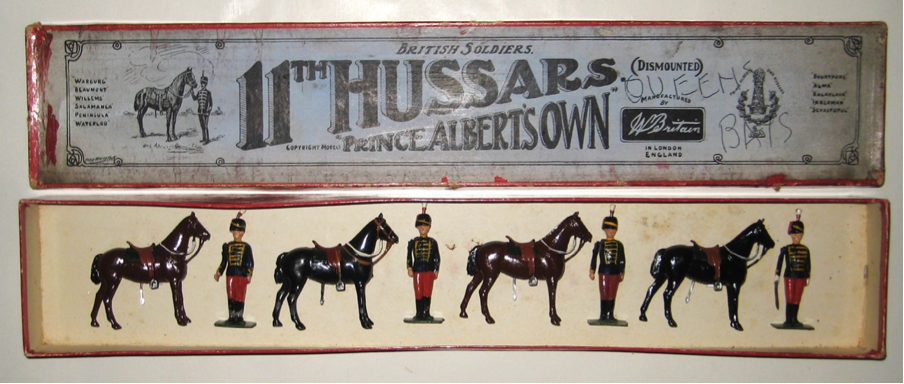
Britains first produced dismounted cavalry quite early on in its sets of toy soldiers. The dismounted 11th Hussars set 182 came out just before the First World War. This set was to remain in the catalogue until well after the Second World War.
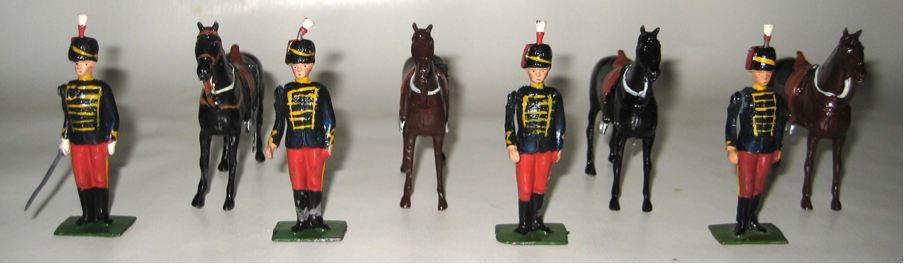
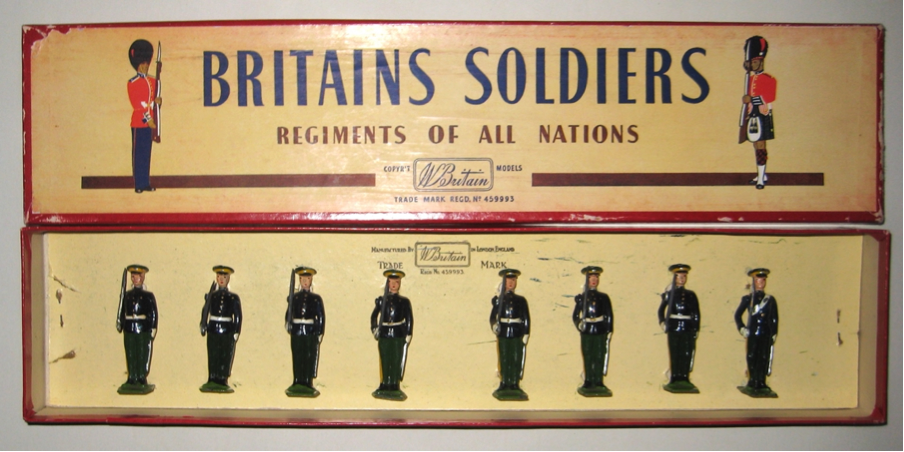
P1 and P2 show the 1930s production of set 182 with its classic Whisstock box. Fine cavalry figures but only 4 and far too much horse flesh. Not sure how you get round that one (till Picture Packs), except that in due course with the second dismounted cavalry set 2087 5th Dragoon Guards, you got 8 troops but no horses (P3) – not ideal either. But 8 soldiers was OK by me!!
So, the only other mainstream listed box of dismounted cavalry, as mentioned, was set 2087, 5th Dragoon Guards (Royal Inniskillings) (P3). This was produced in 1953 in the tranche of full dress regiments brought out at the time of the coronation.
But then thoughts turn to displaying these dismounted 5th Dragoon Guards. What would they look like if they were a set like the 11th Hussars? Well easily done, collect a few spare dismounted cavalry horses and there you go (P4). The one noticeable aspect of my set 2087, as bought, is that even original sets are at the mercy of slight variations in colour as per the trousers seen here. Arising probably from large groups of figures from different times, paint tins and painters put on the assembly bench en masse, as an order for 10 or 20 boxes comes in from a large retailer, in UK, the US or wherever.
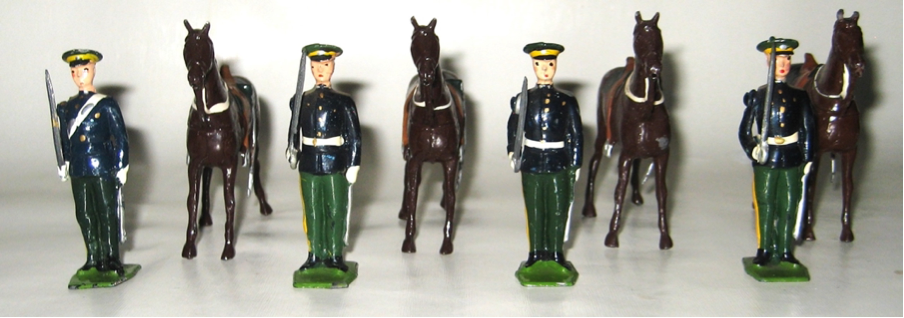
The slightly unsatisfactory aspect of some of these dismounted cavalry depictions is that, although Britains did produce a number of regiments so dismounted, it was only in boxes 182 and 2087 that an officer of these cavalry troopers was ever available. Still the regiments add interest to one’s displays.
So, moving on from the 2 boxed sets we started to get Picture Pack (1954 – 1959) dismounted cavalry troopers and the occasional dismounted figure in the small half box (1957 – 1959) series, such as set 2119 Royal Scots Greys and set 2120 3rd Kings Own Hussars.
To whet the appetite P5 shows all dismounted cavalry figures as produced by Britains in their progressive issues.
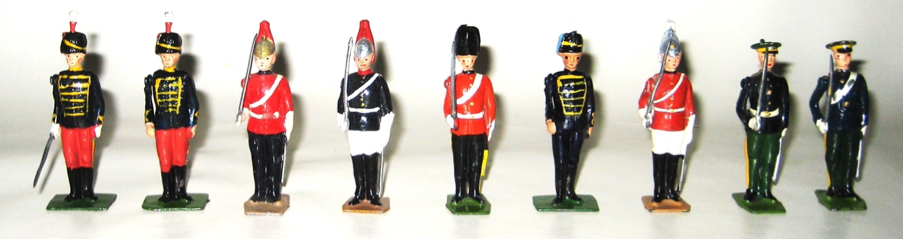
P5 shows the full range available from all the sources over the years, unencumbered with half their role in the army of looking after their horses. These 7 troopers and 2 officers can just stand by themselves and look magnificent in their full-dress uniforms.
Again, these dismounted figures lend themselves to a depiction showing these full-dress troops next to their trusty steeds. The 3 Picture Pack figures for the Life Guards, the Horse Guards and the 1st Dragoon Guards are shown in P6, P7 and P8, but note, no officers.
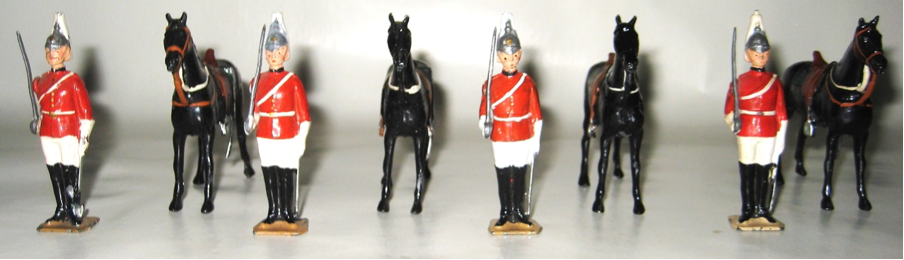
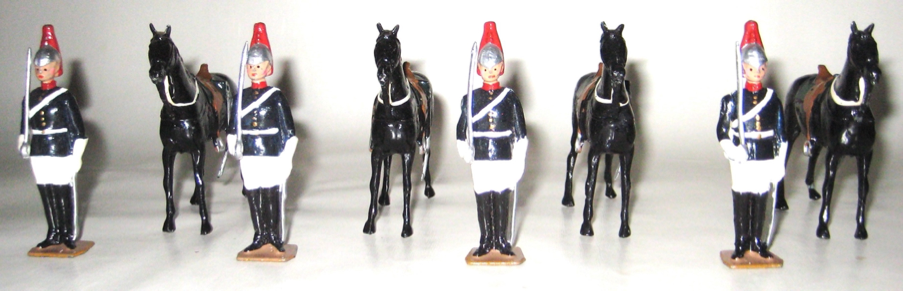
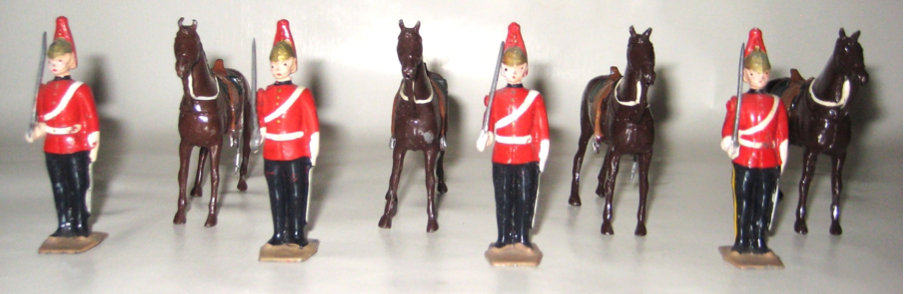
The drawback of the Picture Pack series and the half set boxes was that there were no cavalry officers included (clearly missing from these three pictures above (P6 – P8)). This is, in some ways, detracting. Sadly, in only 2 out of the 7 regimental depictions shown in P5 is there an officer and they stemmed purely from the full set numbered series, as included in the catalogue.
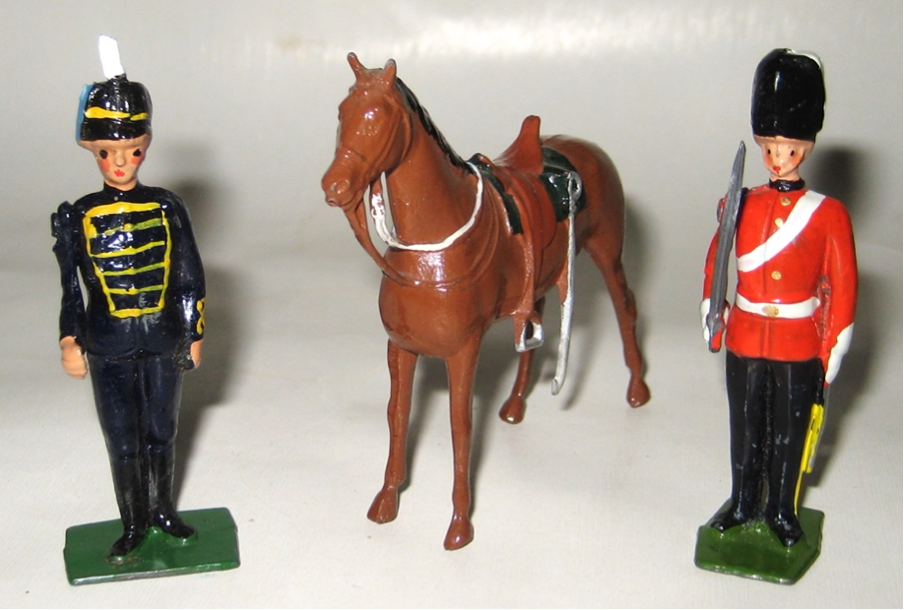
Undoubtedly the figures of the 3rd Hussar and Royal Scot Grey look very attractive in P9 standing next to a horse. They would have looked even better if there were four of each together with steeds, but the plain fact is finding 4 sets of 2129 and four sets of 2119 is virtually impossible. I do not think I have seen more than 2 of each in 40+ years of collecting. The other drawback is that set 2119 did not come with a dismounted white horse! The only way to show a Royal Scot Grey alongside his horse is to paint one oneself. Not yet attempted!
Despite my aversion to the unridden cavalry horse, where having spent funds on a Britains figure and not added to the army strength, there is no doubt that the dismounted cavalry troops look the real thing when paraded alongside their trusty steeds and in composite displays.